MID-AIR: BLOMMERS & SCHUMM, A SUSPENDED RETROSPECTIVE
ART
Words by Elena Cescon
Some artists shape the way we view the world long before we realise it. Their influence grows quietly, through images that stay with us and slowly shift our sense of what is familiar. The Dutch duo Blommers & Schumm, Anuschka Blommers and Niels Schumm, belong to this category.
MID-AIR, their first major solo exhibition at Foam Amsterdam (20 September 2025 – 23 February 2026), documents twenty-five years of work in which they transformed fashion imagery by holding together elements that usually oppose each other. Their photographs sit between clarity and ambiguity, elegance and everyday life, stillness and movement.
The title, MID-AIR: BLOMMERS & SCHUMM, describes the exhibition quite well: standing in front of each work, the viewer enters a breath not yet exhaled. A moment suspended before something happens: a gesture not yet completed, an object not yet fallen, an intimacy not yet formed.
STILLNESS & TENSION: THE ART OF ALMOST COLLAPSE
For Blommers & Schumm, stillness is never synonymous with serenity. It is a choreography of fragile and momentary equilibrium poised on the edge of collapse.
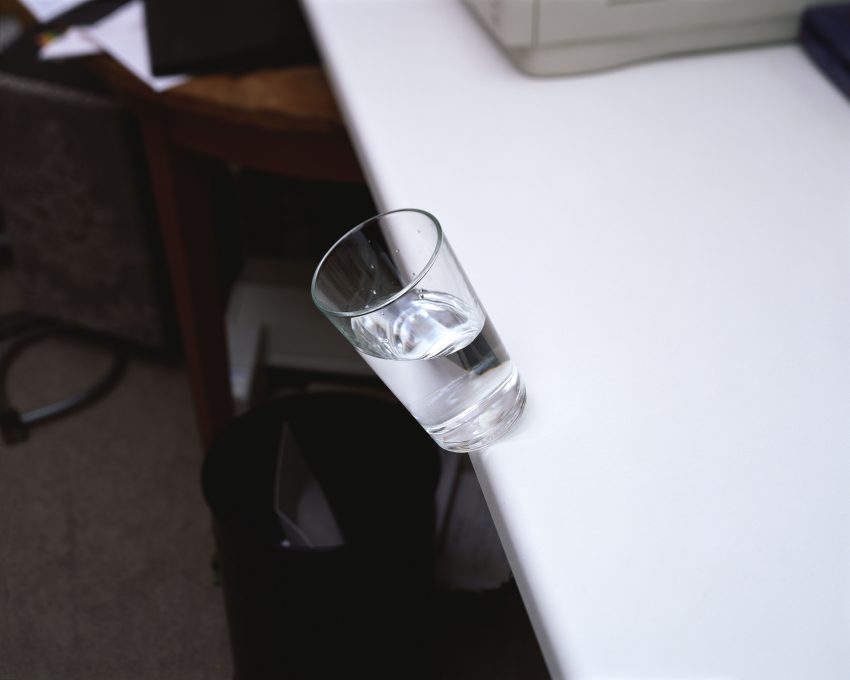
In an era accustomed to digital manipulation, AI-assisted compositions, and heavy post- production, it is crucial to remember that Blommers & Schumm’s images are built entirely in front of the camera. Every levitating plate, every stiff fold of fabric, every just-about-to-tip object carries a tactile weight, a real gravity.
Their stillness is charged with a measurable tension, suggesting a pre-apocalyptic feeling: the intangible moment just before something breaks.
The exhibition opens with Ciara (Self Service, 1998), the duo’s first fashion shoot and the model’s first as well. It is a 154 × 122 cm portrait of a young woman who could just as easily have been our classmate: probably good grades, neutral expression, set against monochrome blue. Her face is inexpressive because, from now on, remember: Blommers & Schumm’s subjects never smile to reassure you.
What unsettles in Ciara is the precision of the composition: a strand of hair placed too perfectly, a clinical light that falls too gently, and a stillness stretched to its limit. This unnatural perfection transpires the feeling of a subtle internal rupture, a contained emotional turbulence, like an escalating frenetic pulse under the skin. The geometric zigzags of her shirt, like a map of nervous lines, fracture the calm surface, giving shape to the invisible tensions running through the composition.
This is one paradox that defines Blommers & Schumm: an anti-theatrical aesthetic that becomes dramatic through its refusal to emote.
HUMAN RELATION & APATHY: CONNECTION WITHOUT WARMTH
In the first room, visitors are confronted with the theme of Human Interaction, a subject that, in Blommers & Schumm’s hands, becomes quietly ambiguous. It is intimacy drained of sentiment, desire stripped of heat, as if human connection had been reduced to its pure mechanics.
Investigation of Human Interaction in Eroticism (Carcy Magazine, 2018) presents three bodies arranged in what should be an erotic pose, yet the atmosphere is unmistakably cold. The scene feels like a post-human future in which touch remains, but tenderness has disappeared. The bodies are present but distant; their movements precise but emptied of emotion. What could have been a moment of closeness becomes instead a study in dissonance: a world where touch no longer ensures warmth, and where the fragile codes of intimacy have been reset to zero.
A similar tension appears in Double Portrait (COS, 2015). Two figures overlap: one turns their back, the other faces us slightly. Their features are deliberately neutral, and only the length of their hair hints at gender. At first, you think you’re looking at a man and a woman, until you realize that your assumption rests on a single, fragile detail. Suddenly you understand that, in Blommers & Schumm’s universe, gender is not fixed but a shifting architecture.
In Double Portrait, the duo creates a quiet balance, almost like yin and yang, two presences holding each other in place without ever revealing exactly who they are.
©️ Blommers & Schumm.
FASHION & FAMILIAR: THE ORDINARY BECOMES EXTRAORDINARY
As the exhibition unfolds, it becomes clear that very few artists navigate the space between luxury and everyday life with the precision of Blommers & Schumm.
They have shot for Versace, Gucci, Balenciaga, Hermès, Bottega Veneta, LOEWE, Viktor & Rolf, and Louis Vuitton; yet the central figure in their images is often an ordinary person framed by a living room, a hallway, or a bathroom door. This is their most radical move: making high fashion ordinary, and making ordinariness fashionable.
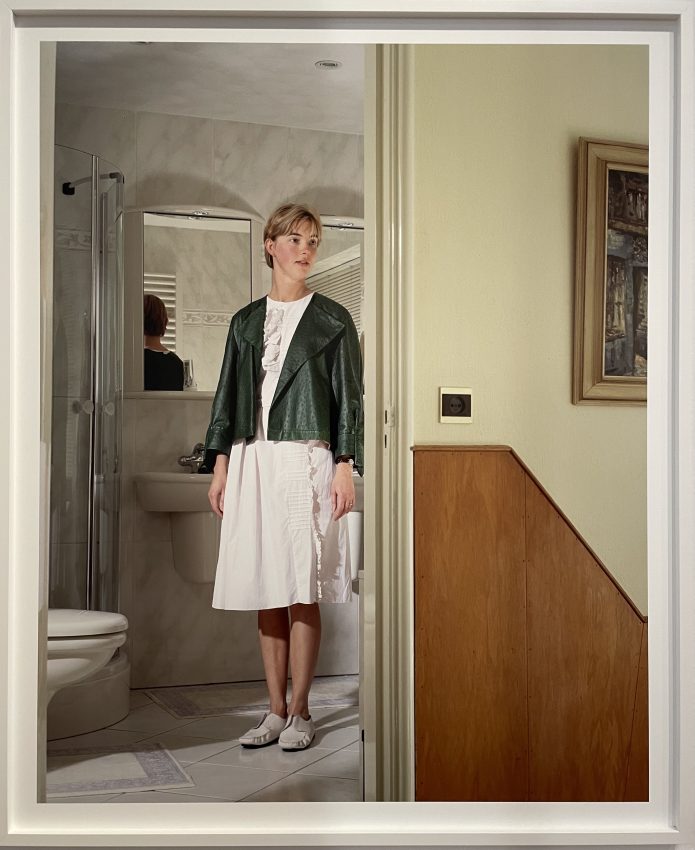
As early as 1999, the duo was staging haute couture looks on everyday figures – parents, siblings, friends – inside domestic spaces, subtly erasing the boundary between luxury and domesticity.
Anuschka’s dad at home (Frans for Self Service, 1999), dressed head-to-toe in a Maison Margiela look and standing in the living-room doorway, or Niels’ sister-in-law at home (Self Service, 1999), posing in her bathroom in an André Walker outfit, demonstrate how the familiar becomes iconic. The warmth of home is there, but filtered through an aesthetic that avoids sentimentality, leaving only what is needed to create portraits that feel both personal and anonymous.
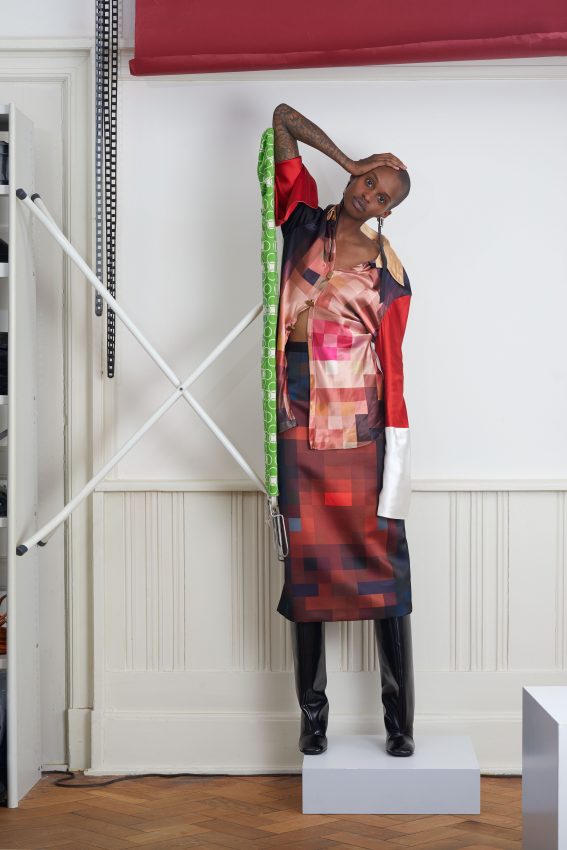
Two decades later, this visual language persists. In On the ironing board ( Nella for Buffalo Magazine, 2019), a model stands balanced on an ironing board in the duo’s studio: suspended, expressionless, held in pause. It is an image where fashion is presented not as aspiration but as perception, grounded in the ordinary that gives it substance.
Blommers & Schumm’s work is both historical and timeless: the ordinary becomes extraordinary, the banal becomes iconic, and photography becomes a quiet study of tension, stillness, human relations, and identity.
MID-AIR: BLOMMERS & SCHUMM, the retrospective at the Foam Photography Museum in Amsterdam, reveals the quiet thread that has shaped their work for more than twenty-five years.
Rather than explain, Blommers & Schumm let their images speak: through pauses, neutrality, and moments suspended between states. Everything is in mid-air.
Everything is about to fall, or perhaps finally fall into place.
Blommers & Schumm – Mid-Air
FOAM MUSEUM AMSTERDAM
20 September 2025 – 23 February 2026
Foam | www.foam.org
COURTESY OF FOAM MUSEUM
COURTESY OF THE ARTISTS ANUSCHKA BLOMMERS AND NIELS SCHUMM
TEXT BY ELENA CESCON
Investigation of human interaction in eroticism Carcy Magazine, Styling Hannes Hetta, 2018 © Blommers & Schumm.
Anuschka’s dad at home wearing Maison Margiela Frans for Selfservice Magazine, styling Suzanne Koller, 1999 © Blommers & Schumm.
Josefina wearing Bless, styling Georgia Pendlebury for Exhibition Magazine, 2018 © Blommers & Schumm.
Nadja for Buffalo Magazine, Styling by Harry Lambert, 2019 © Blommers & Schumm.
Tanga in Navy for Gentlewoman, art director Jop van Bennekom, styling Jodie Barnes, 2010 © Blommers & Schumm
Double Portrait COS, 2015 © Blommers & Schumm.